Dartmoor24 - The Project!
Publication date: 18 July 2026
Dartmoor24 is a substantial, multi-media, project that I began in the spring of 2026 and is unlikely to be finished much before the spring of 2028.
The idea began with a simple concept: 24 images based around the Dartmoor landscape and its folklore, where each image represented one hour in the 24-hour day cycle.
I began the project by producing a 24-frame concertina charcoal drawing where each 7x12cm panel represents one hour.
I decided that the panels should form a contiguous image (but I allowed myself the flexibility to take liberties with the geography - so if you are familiar with Dartmoor, you will notice that I've moved landscape form and features to help me create the image flow).
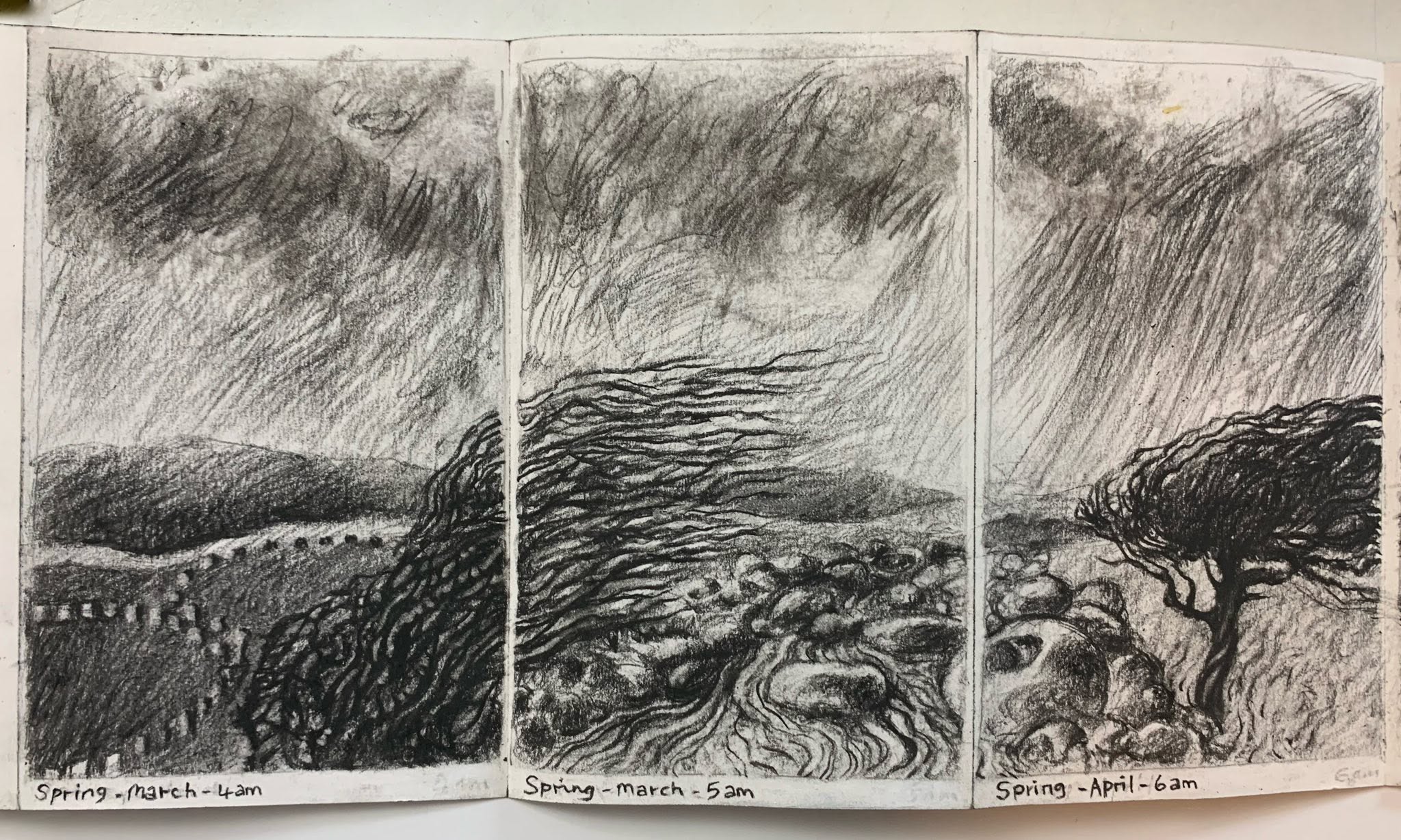
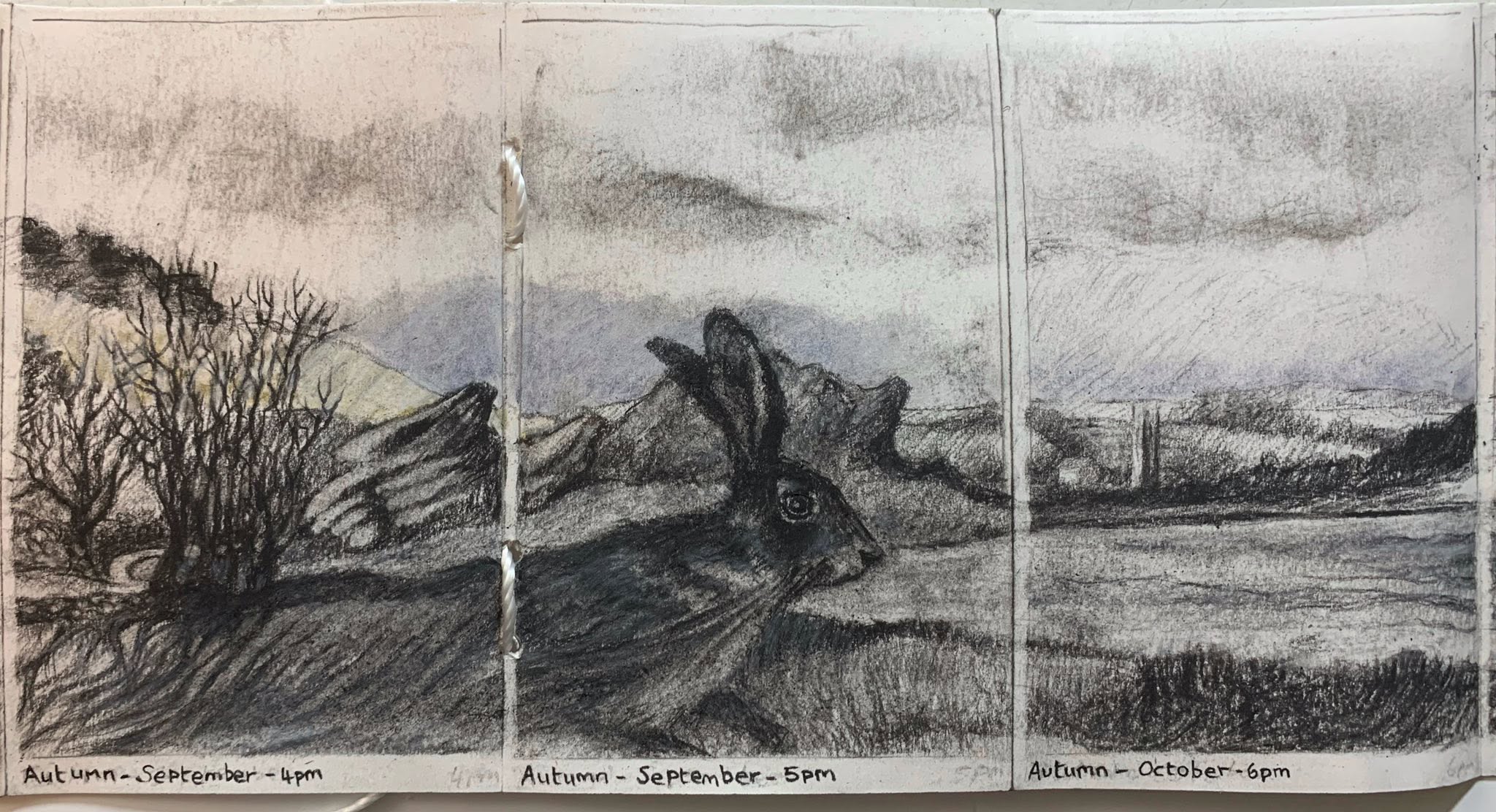
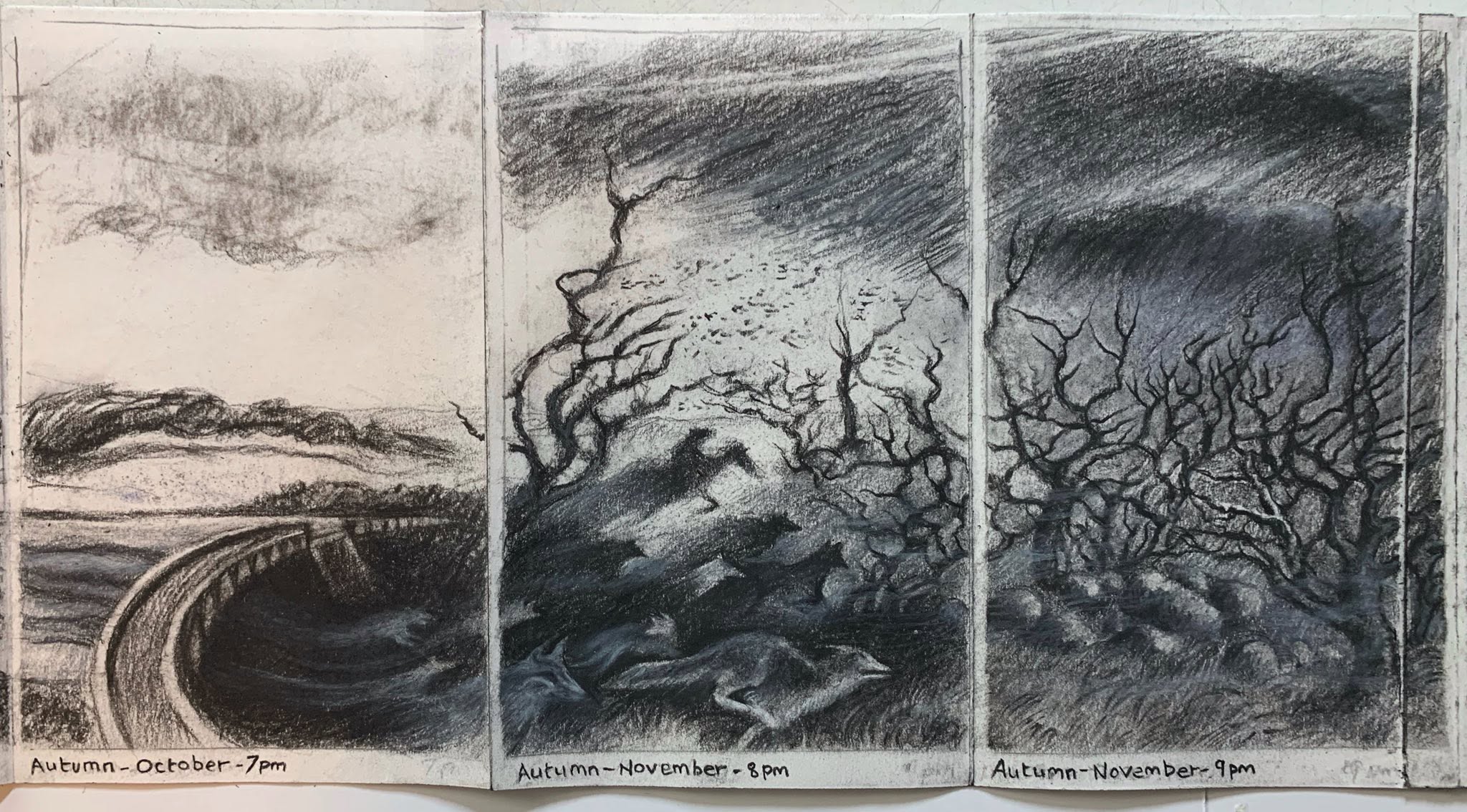
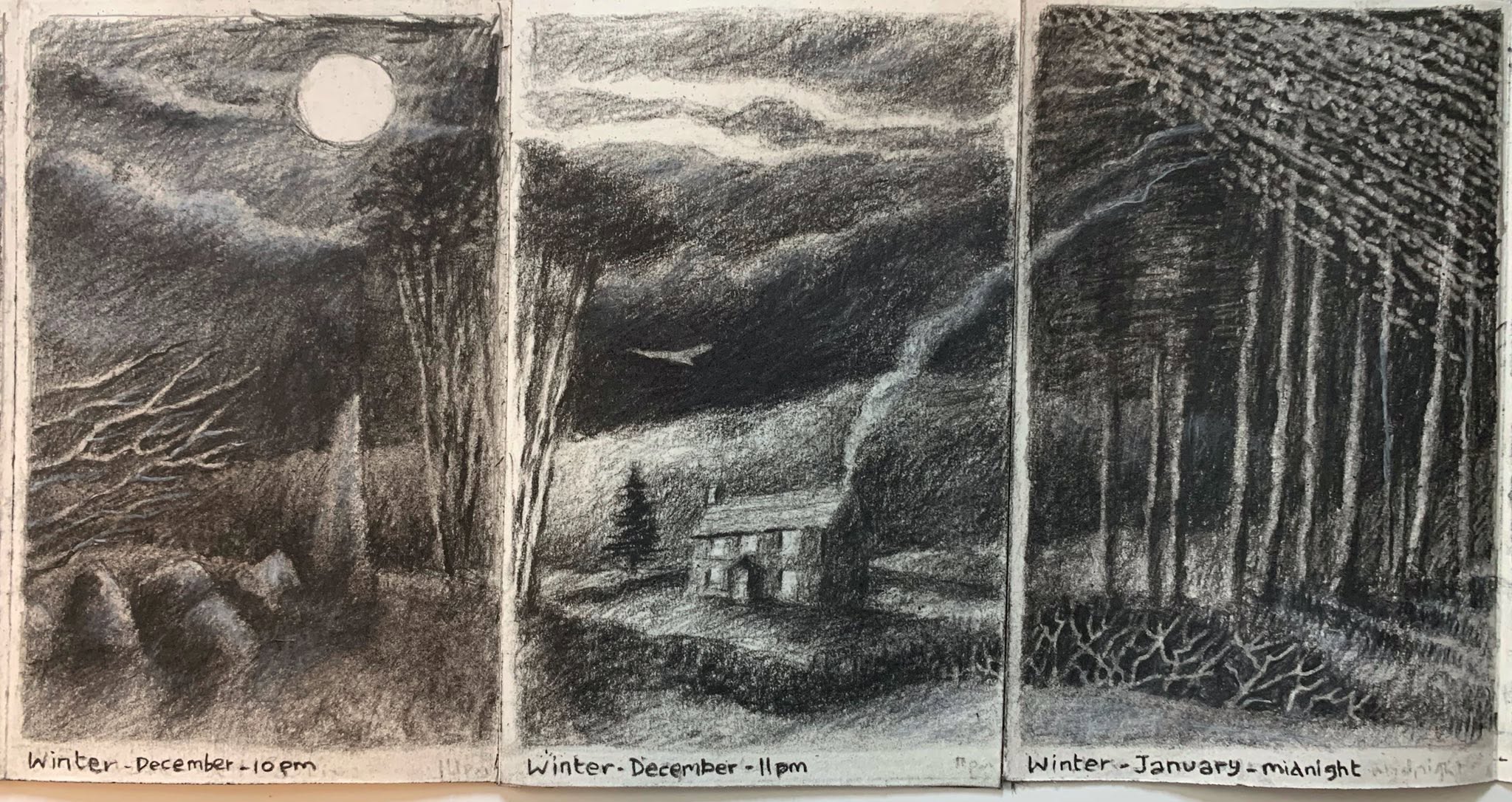
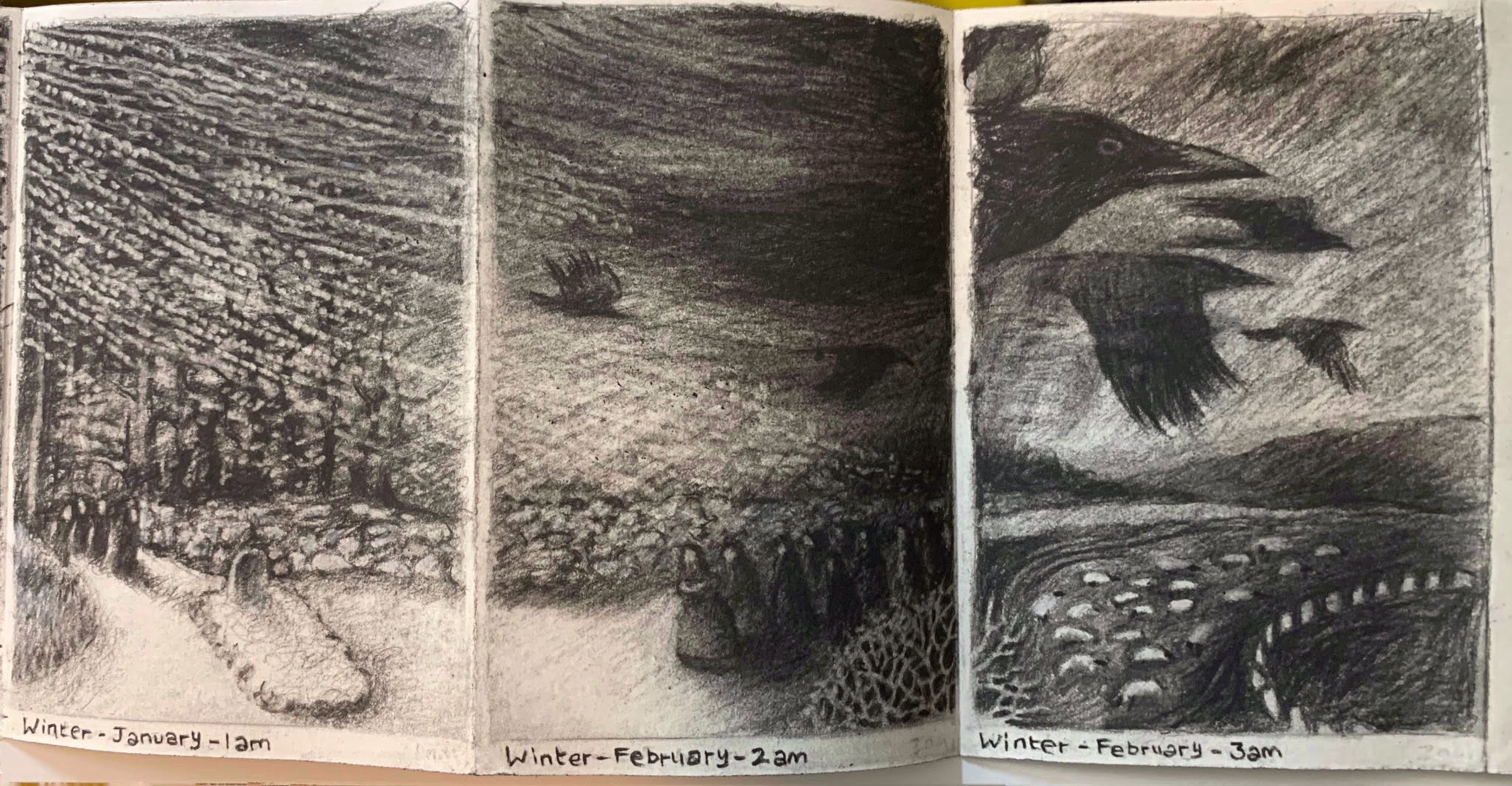
Pictured below is the full concertina drawing, and, following that, close-ups of each set of three panels.
This narrative continues after the drawings...

Dartmoor24 is a substantial, multi-media, project that I began in the spring of 2026 and is unlikely to be finished much before the spring of 2028.
The idea began with a simple concept: 24 images based around the Dartmoor landscape and its folklore, where each image represented one hour in the 24-hour day cycle.
I began the project by producing a 24-frame concertina charcoal drawing where each 7x12cm panel represents one hour.
I decided that the panels should form a contiguous image (but I allowed myself the flexibility to take liberties with the geography - so if you are familiar with Dartmoor, you will notice that I've moved landscape form and features to help me create the image flow).
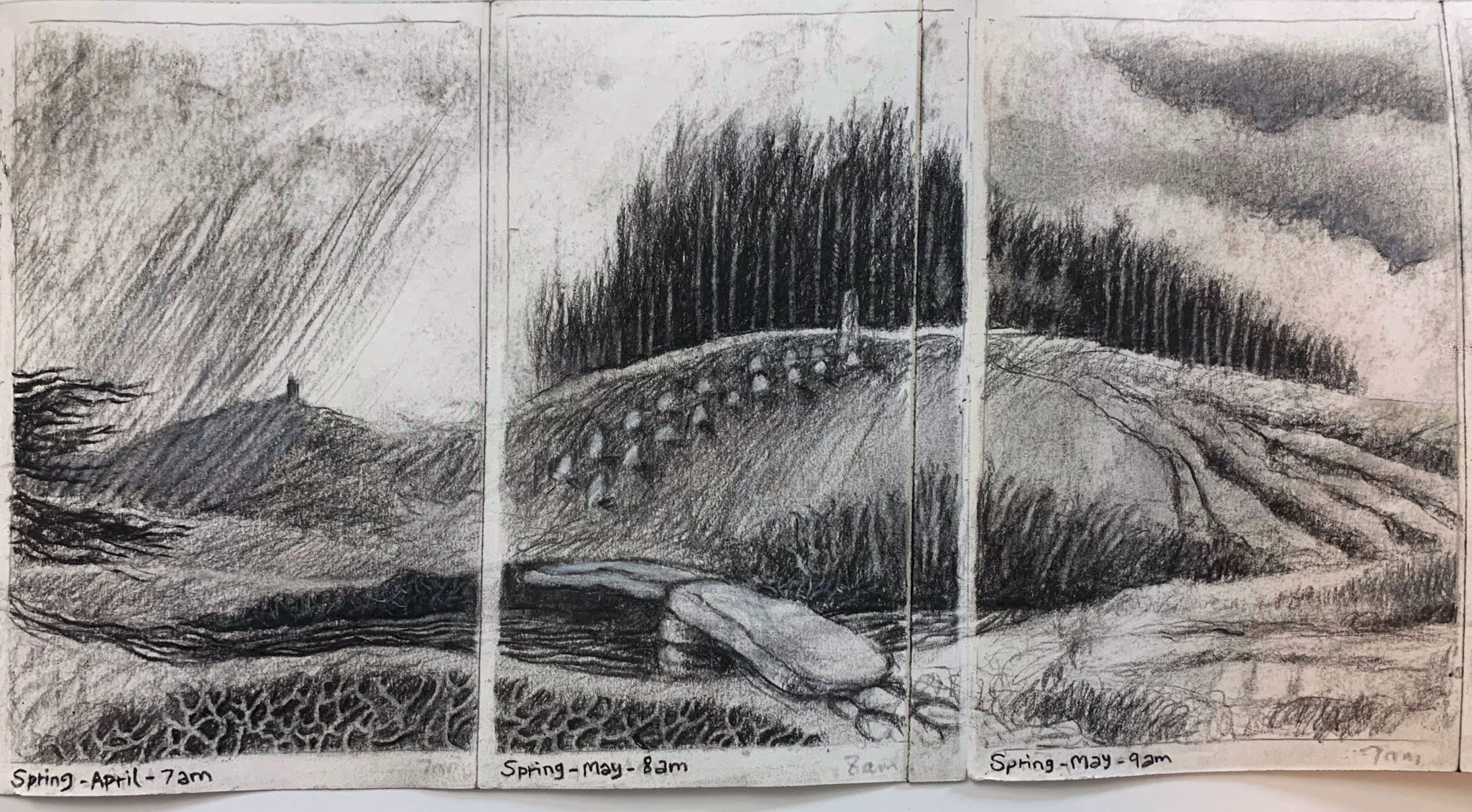
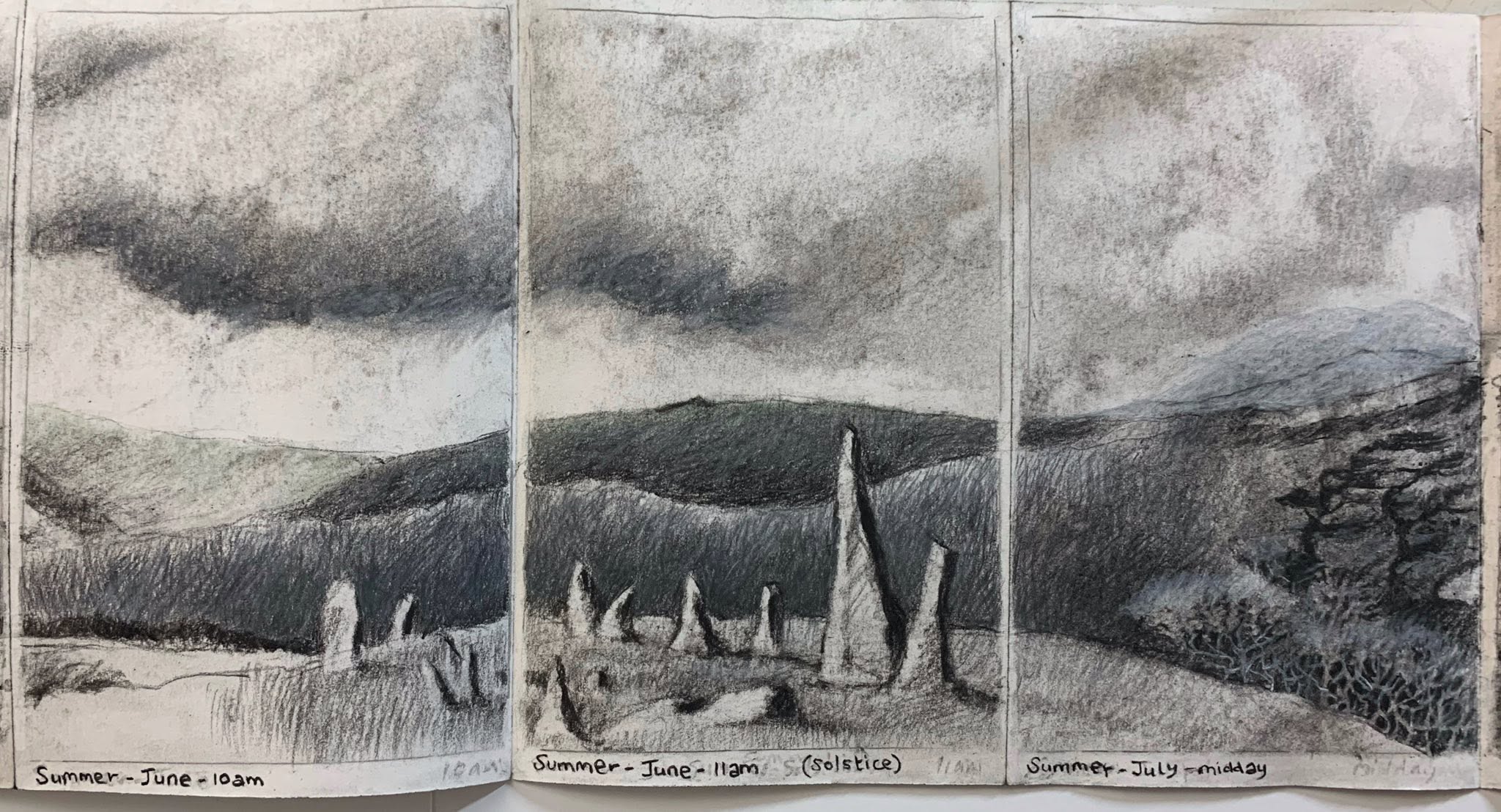
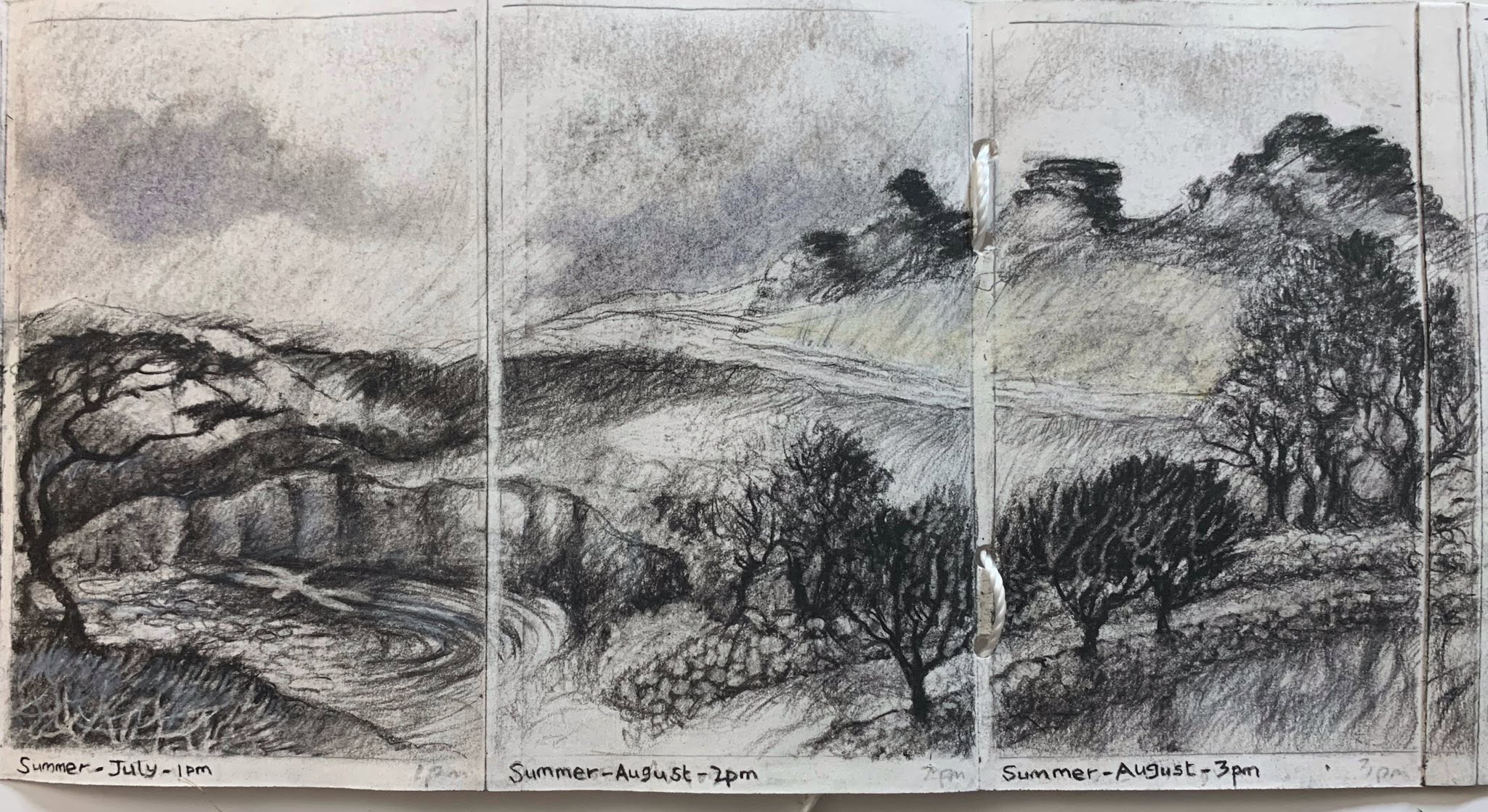
Pictured below is the full concertina drawing, and, following that, close-ups of each set of three panels.
This narrative continues after the drawings...
Above: Image 1
The 24-panel charcoal drawing that is the starting point for everything that follows (you can click this image to see a larger version)
The 24-panel charcoal drawing that is the starting point for everything that follows (you can click this image to see a larger version)
Above: Image 2
Panels featuring the Grey Wethers stone circles and the Tolmen Stone
Panels featuring the Grey Wethers stone circles and the Tolmen Stone
Above: Image 3
Panels featuring Brent Tor church, and the stone rows and clapper bridge on Gidleigh Common
Panels featuring Brent Tor church, and the stone rows and clapper bridge on Gidleigh Common
Above: Image 4
Panels featuring Scorhill stone circle
Panels featuring Scorhill stone circle
Above: Image 5
Panels featuring the disused quarry at Hay Tor and, on the horizon, Hound Tor
Panels featuring the disused quarry at Hay Tor and, on the horizon, Hound Tor
Above: Image 6
Panels featuring the church at Widecombe
Panels featuring the church at Widecombe
Above: Image 7
Panels featuring the Avon Dam reservoir, the Wisht Hounds and Wistman's Wood
Panels featuring the Avon Dam reservoir, the Wisht Hounds and Wistman's Wood
Above: Image 8
Panels featuring the farm at Nun's Cross
Panels featuring the farm at Nun's Cross
Above: Image 9
Panels featuring Kitty Jay's grave and the Grey Wethers stone circle (the right-hand panel here reconnects to the first panel in the 24-hour panel sequence (see Image2)
This drawing has been evolving over time. I've been making many changes to it - introducing some new elements, removing some along the way.
One early change was to introduce the idea of the seasons - so that each sequence of 8 panels represented a season. This meant that the images had to be adjusted to allow for changes in the weather which, themselves, were subject to the 24-hour concept.
Another 'rule' I decided to follow, was to make each individual panel work as a composition in it's own right - so that each could be viewed on its own, and on its own merit. But after deciding to include the seasons, I also made the decision to develop the panels in groups of three, so that each consequtive trypych would be made into a print (where the image would be on a larger scale than those in the initial drawing).
This decision meant that each tryptych also needed to work as a stand-alone composition. This is a challenge in itself, given my intention to have the composition of the individual panels work effectively - it doesn't follow that three well-composed panels will add up to a well-composed tryptych!
The next three images show part of the journey into the next stage of the project. This narrative will continues after Image 12.
Panels featuring Kitty Jay's grave and the Grey Wethers stone circle (the right-hand panel here reconnects to the first panel in the 24-hour panel sequence (see Image2)
This drawing has been evolving over time. I've been making many changes to it - introducing some new elements, removing some along the way.
One early change was to introduce the idea of the seasons - so that each sequence of 8 panels represented a season. This meant that the images had to be adjusted to allow for changes in the weather which, themselves, were subject to the 24-hour concept.
Another 'rule' I decided to follow, was to make each individual panel work as a composition in it's own right - so that each could be viewed on its own, and on its own merit. But after deciding to include the seasons, I also made the decision to develop the panels in groups of three, so that each consequtive trypych would be made into a print (where the image would be on a larger scale than those in the initial drawing).
This decision meant that each tryptych also needed to work as a stand-alone composition. This is a challenge in itself, given my intention to have the composition of the individual panels work effectively - it doesn't follow that three well-composed panels will add up to a well-composed tryptych!
The next three images show part of the journey into the next stage of the project. This narrative will continues after Image 12.
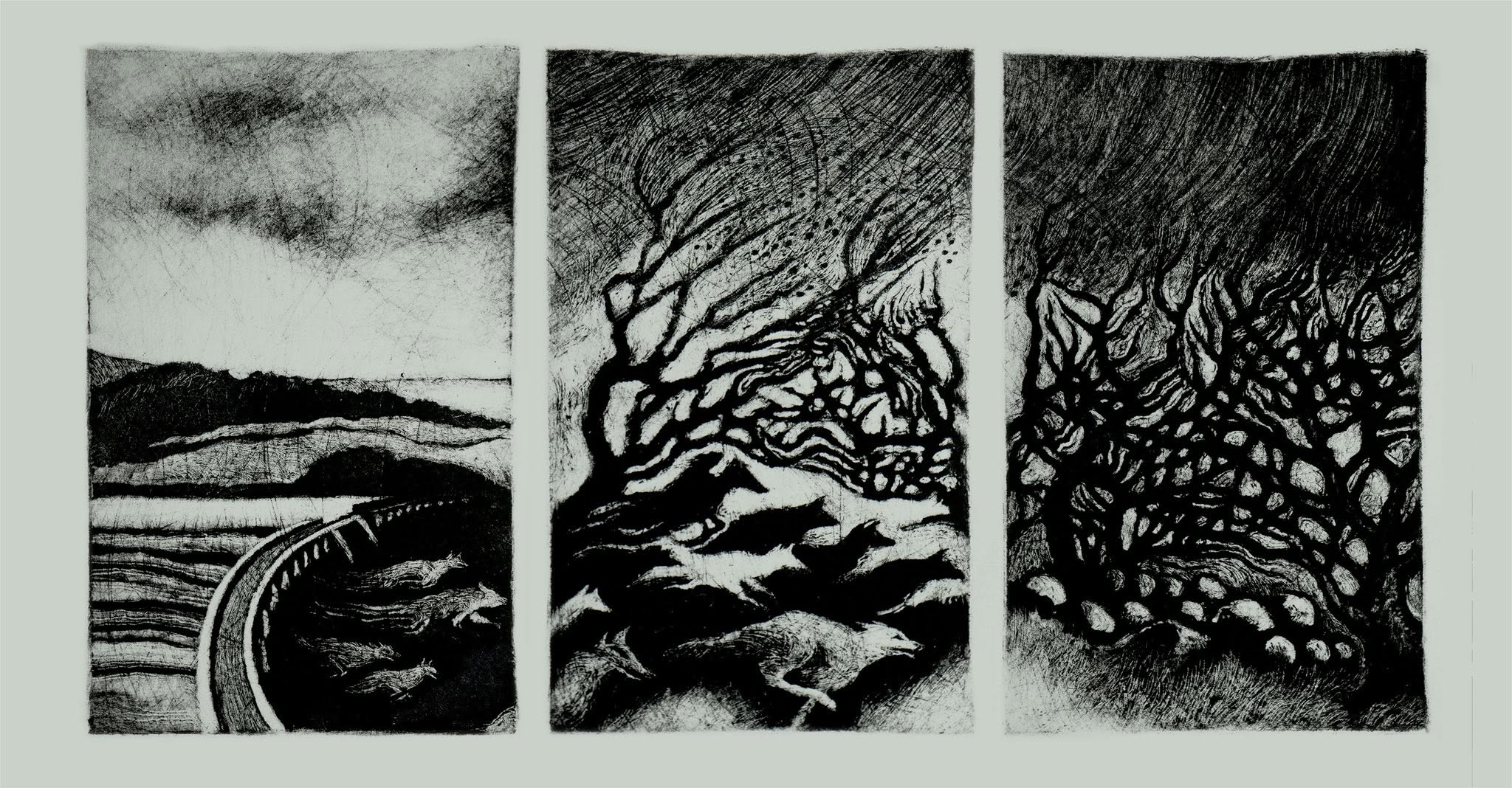
Above: Image 10: Monotype - The Wisht Hunt
I decided to make larger-scale linoprints from each tryptych. But I didn't want to work directly from the charcoal drawing - not least because translating all the greyscales didn't appeal. Instead, I've decided to copy my drawing into same-size monotype prints (these are made by coating a piece of plastic - the block - with etching ink, which I then wipe away with various tools to create the image - essentially wiping away the ink to create the lighter areas - I then print from the block onto dampened paper. The image above show the three monotype panels based on the drawing shown in Image 7. Note that I'm not slavishly following the drawn image - the monotype technique that I use suggests some new elements and texture - so the image evolves through the technique
I decided to make larger-scale linoprints from each tryptych. But I didn't want to work directly from the charcoal drawing - not least because translating all the greyscales didn't appeal. Instead, I've decided to copy my drawing into same-size monotype prints (these are made by coating a piece of plastic - the block - with etching ink, which I then wipe away with various tools to create the image - essentially wiping away the ink to create the lighter areas - I then print from the block onto dampened paper. The image above show the three monotype panels based on the drawing shown in Image 7. Note that I'm not slavishly following the drawn image - the monotype technique that I use suggests some new elements and texture - so the image evolves through the technique
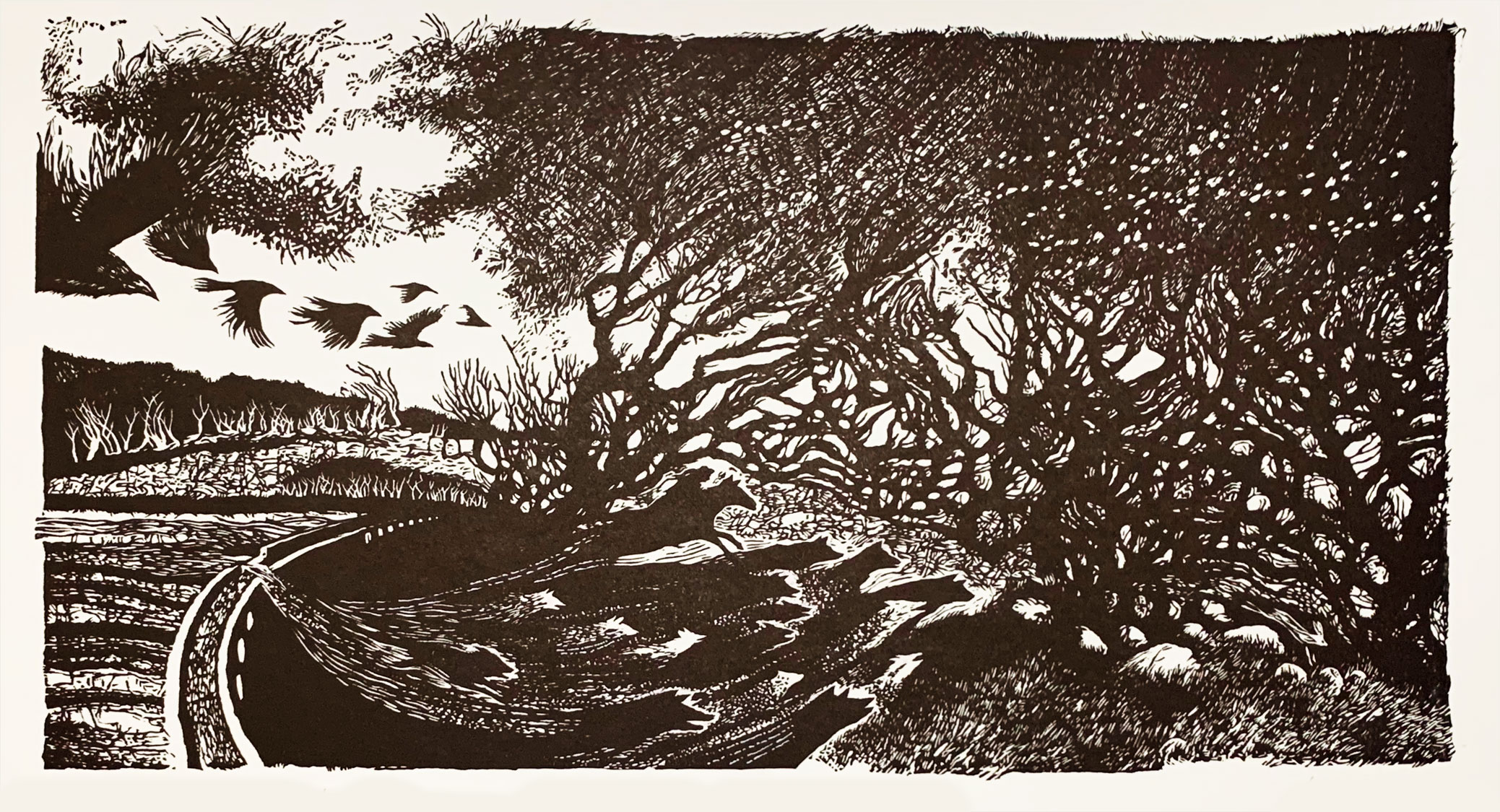
Above: Image 11: Black and white linoprint - The Wish Hunt (50x27cm - edition of 10)
I photographed the monotype prints and opened them in my image-editing software, where I removed the dividing borders to create a single image. I then scaled up the image roughly x4.
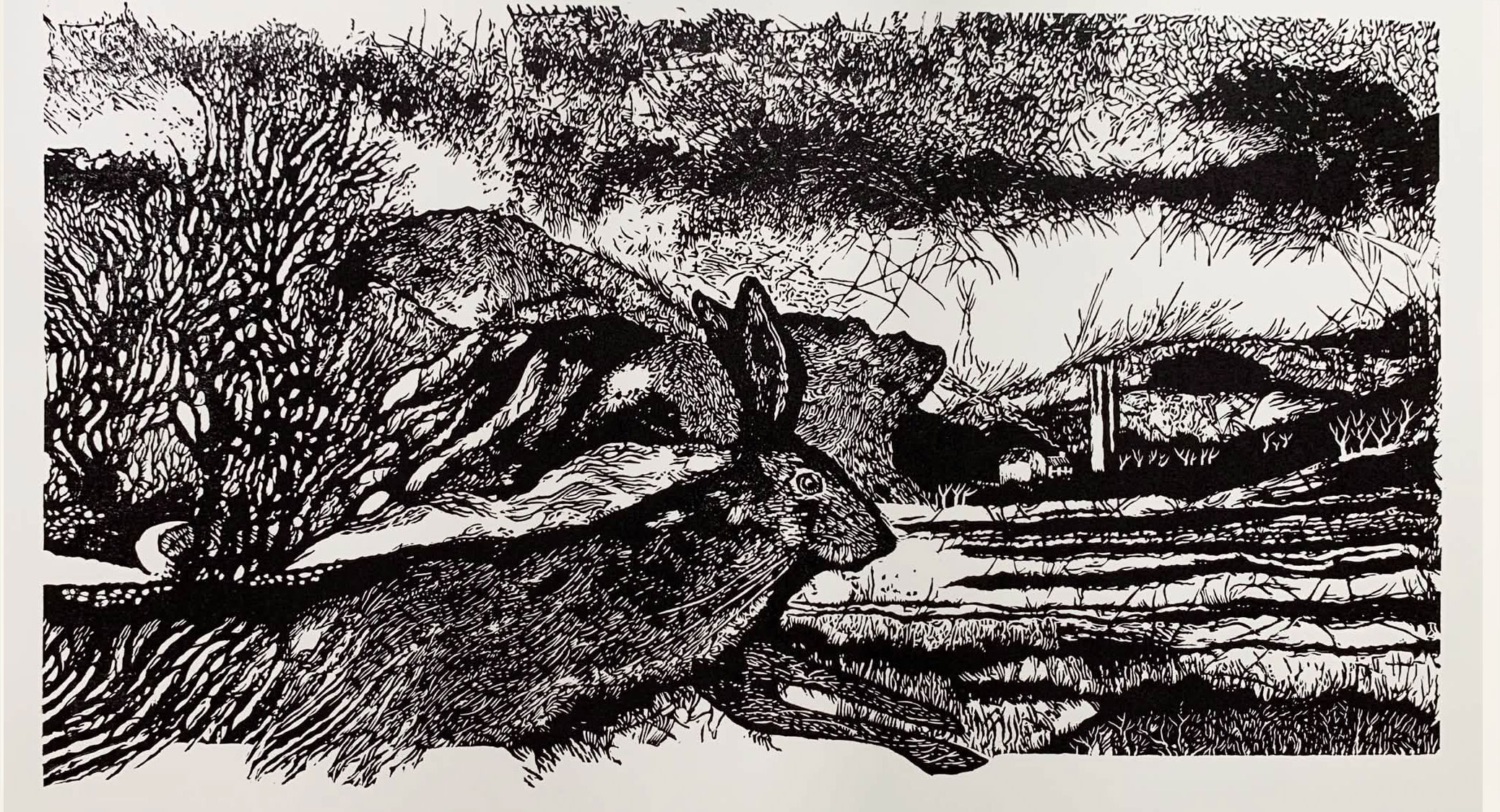
The enlarged image was then transferred to the surface of the lino block, ready for cutting. More adjustments were made to the image when it was on the lino (working at this much larger scale allows for signficant changes to the content). I also wanted to reproduce in the linoprint the textures I'd achieved in the monotype prints - this approach adds a degree of complexity and detail to the linoprint, which appeals to me. The final result at this stage is a limited edition of 10 prints.
I photographed the monotype prints and opened them in my image-editing software, where I removed the dividing borders to create a single image. I then scaled up the image roughly x4.
The enlarged image was then transferred to the surface of the lino block, ready for cutting. More adjustments were made to the image when it was on the lino (working at this much larger scale allows for signficant changes to the content). I also wanted to reproduce in the linoprint the textures I'd achieved in the monotype prints - this approach adds a degree of complexity and detail to the linoprint, which appeals to me. The final result at this stage is a limited edition of 10 prints.
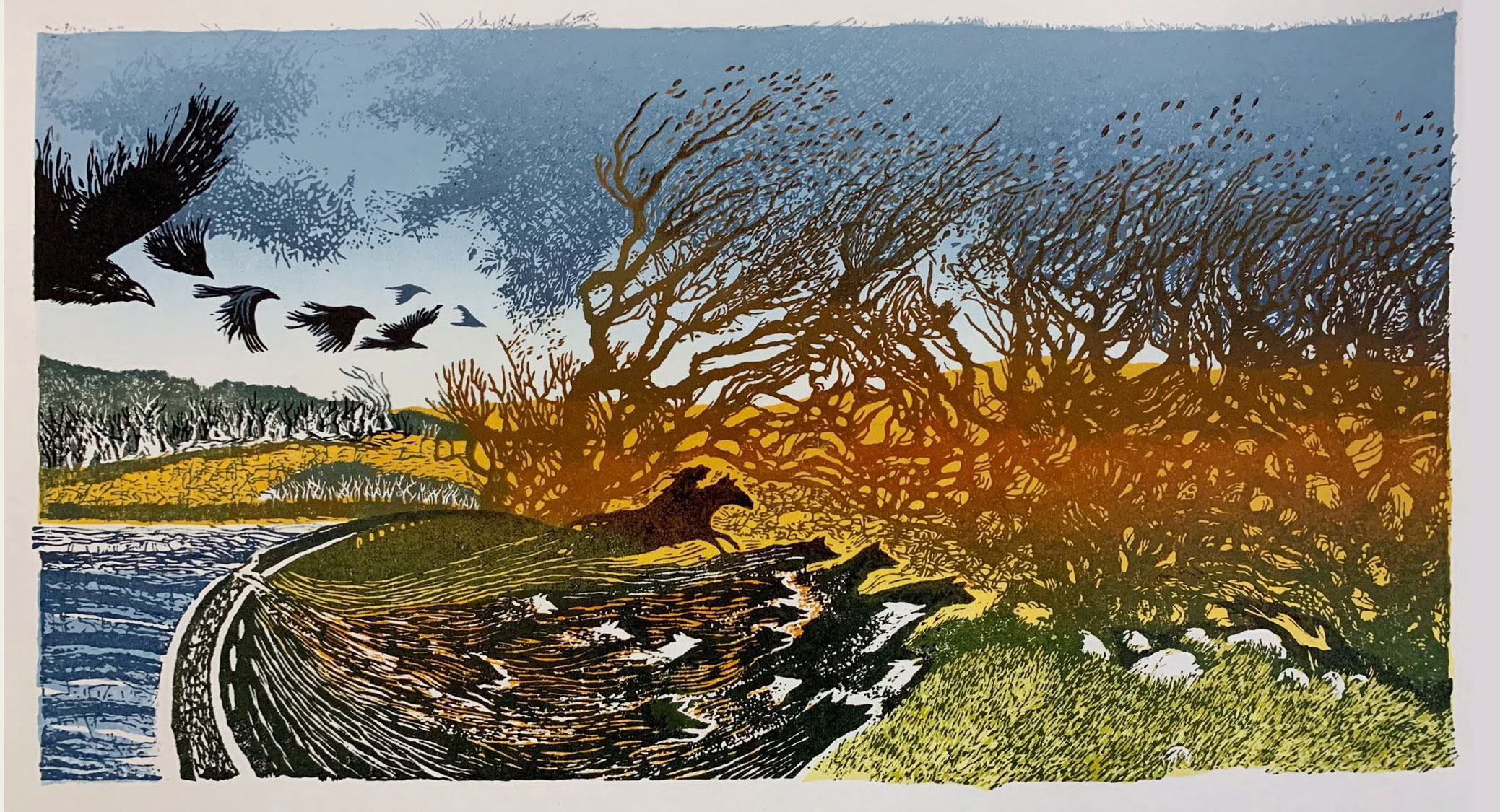
Above: Image 12: Colour linoprint - The Wisht Hunt (50x27cm - edition of 20)
Having produced the black and white edition of this image, I then went on to create the full colour version. This uses the linoprint technique referred to as 'reduction', where the same lino block is used to print the different colours, beginning with the lightest colour. After each colour is printed, the part of the print that have to be represented by that colour are cut away from the block before the next, darker, colour is printed. In this way, the original lino block is progressively destroyed. I used another lino block to print the sky and the moorland in the background - but otherwise, everything is printed from the main block. This has resulted in a limited edition of 20 prints.
Having produced the black and white edition of this image, I then went on to create the full colour version. This uses the linoprint technique referred to as 'reduction', where the same lino block is used to print the different colours, beginning with the lightest colour. After each colour is printed, the part of the print that have to be represented by that colour are cut away from the block before the next, darker, colour is printed. In this way, the original lino block is progressively destroyed. I used another lino block to print the sky and the moorland in the background - but otherwise, everything is printed from the main block. This has resulted in a limited edition of 20 prints.
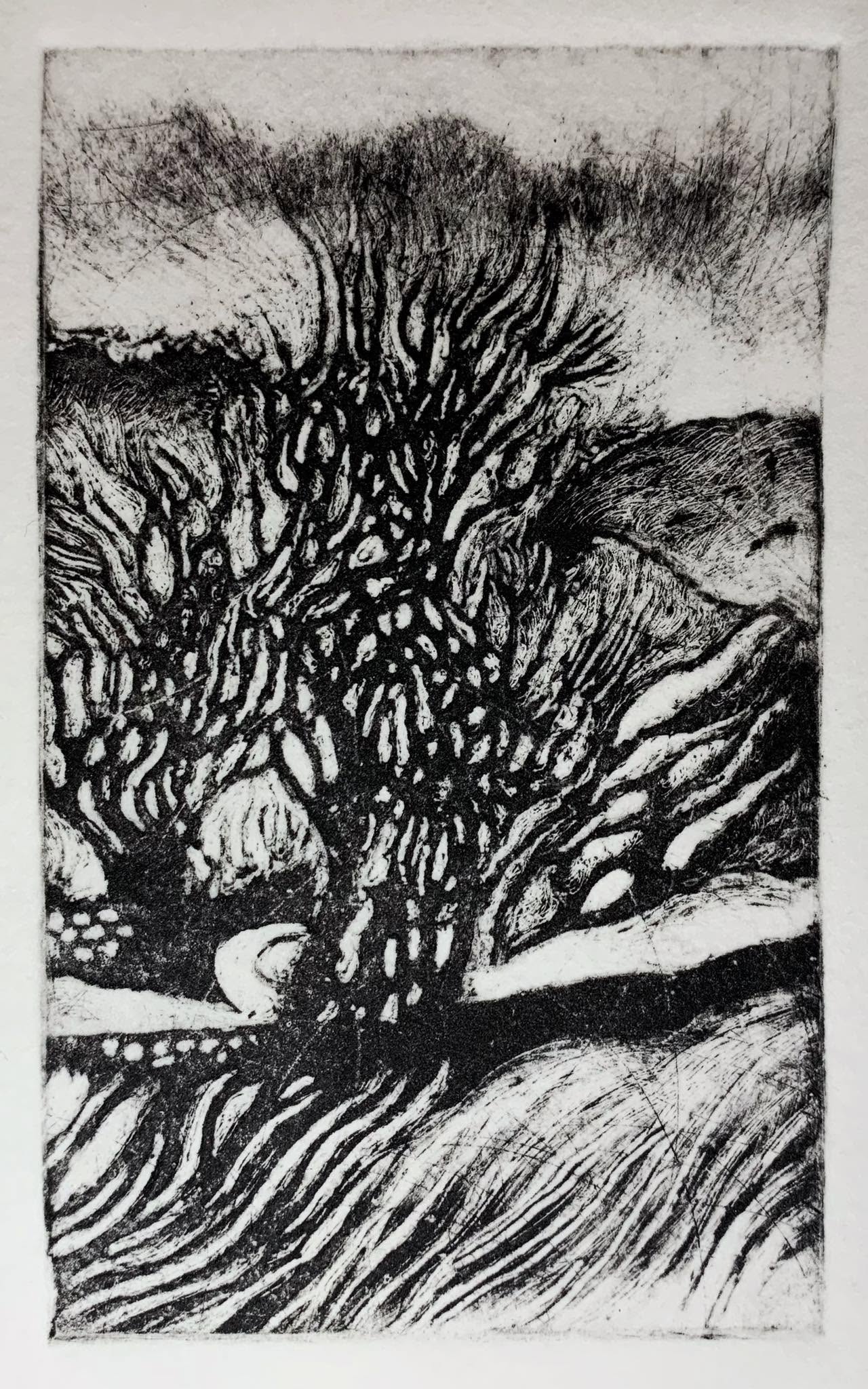
Above: Image 13: One of the monotype prints from a set of three that was used for the next image
I decided to start with the Wisht Hunt tryptych because I knew it would be the most challenging. Consequently, I'll be moving forward and back from that tryptych as a works through all the images.
So the monotype above led to the black and white linoprint below - 'Widecombe Hare'.
I decided to start with the Wisht Hunt tryptych because I knew it would be the most challenging. Consequently, I'll be moving forward and back from that tryptych as a works through all the images.
So the monotype above led to the black and white linoprint below - 'Widecombe Hare'.
Above: Image 14: Black and white linoprint - Widecombe Hare (50x27cm - edition of 10)
The project will be largely completed when I've created a small monotype of each of the 24 panels, plus a large black and white 10-print edition and a large full-colour 20-print edition linoprint of each of the eight tryptychs.
And, of course, this really should be enough for anyone, shouldn't it?
Well... I've also been thinking about producing mezzotint editions of each tryptych. Apart from my love of the mezzotint printmaking technique, this medium will allow an even greater amount of detail and tonality. My plan is to produce 8 mezzotint editions that will add a lot more to the stories told in the drawings, monotypes and linoprints.
If you find all this of interest, please check back from time to time - I will be updating this page with images as the project progresses.
The project is quite an expensive one, so I'm making some of the linoprints available for purchase prior to the completion of the project - please click here to find them in my Portfolio/Shop
I will also be issuing progress reports in my Email Newsletter (including details about the exhibition of this project), so if you're not already on the list you can join by following the link below:
Newsletter subscription
The project will be largely completed when I've created a small monotype of each of the 24 panels, plus a large black and white 10-print edition and a large full-colour 20-print edition linoprint of each of the eight tryptychs.
And, of course, this really should be enough for anyone, shouldn't it?
Well... I've also been thinking about producing mezzotint editions of each tryptych. Apart from my love of the mezzotint printmaking technique, this medium will allow an even greater amount of detail and tonality. My plan is to produce 8 mezzotint editions that will add a lot more to the stories told in the drawings, monotypes and linoprints.
If you find all this of interest, please check back from time to time - I will be updating this page with images as the project progresses.
The project is quite an expensive one, so I'm making some of the linoprints available for purchase prior to the completion of the project - please click here to find them in my Portfolio/Shop
I will also be issuing progress reports in my Email Newsletter (including details about the exhibition of this project), so if you're not already on the list you can join by following the link below:
Newsletter subscription
Connect


My newsletter: